



























Okay, so a small confession first. Bodybuilding and its endless fads can get extremely confusing, so we started Bodybuilding Inner Circle as a cozy little corner of the internet where anyone could find free, no-nonsense information without piecing it together from twenty different places.
Somewhere along the way, that little corner went on a serious bulk and turned into a rather enormous library. How enormous? We had to pull a report to find out, and let’s just say the number made us blink a few times.
New guides were going up every week across nutrition, workout programs, supplements, general health, and just about everything in between. Meanwhile, older ones sat on the shelf, quietly doing their best without a spotter in sight.
That shelf is what we brought AM Marketing SEO in to help us sort out, roughly two years ago.
Of course, we were a little skeptical at first. We’d come across enough SEO pitches by then to notice they all sounded suspiciously identical: better rankings, more traffic, incredible results, the digital version of a fat burner promising ten pounds by Friday. Anyone who has spent five minutes in the bodybuilding world learns not to trust a promise just because it sounds impressive.
Working with these guys turned out to be a different experience. There was no magic trick up their sleeves, only steady work, month after month, the kind of progressive overload that adds up when you give it time. We could see exactly what was being done, and since we like to see the receipts before getting excited about anything, we were glad there were plenty to look at.
So here’s our review, written the way we’d tell a fellow website owner over a cup of tea (or a protein shake, whichever you prefer) if they asked us if AM Marketing SEO is worth it.
The Content Problem We Had
Our story is a bit different from the usual one, where an agency swoops in, finds a dozen quick fixes, and everybody throws a party a few months later.
As a site that has been publishing guides for years, we had content. Lots and lots of it.
And among all those guides, plenty needed a sharper angle, a fresh pair of eyes, or a quick check against what people are actually typing into Google these days (and into AI tools, which is a whole new adventure).
Fitness advice moves fast, so a guide that ranked nicely a few years ago can quietly slip down the results without anyone noticing. On top of that, newer articles had been tiptoeing onto the same ground as older ones, and our internal linking was, shall we say, a work in progress.
Our goal has always been to offer free, no-nonsense information in one spot, so making smarter use of what we already had mattered a lot more to us than simply publishing more.
That was pretty much the plan laid out in one of the very first emails we got from the team.
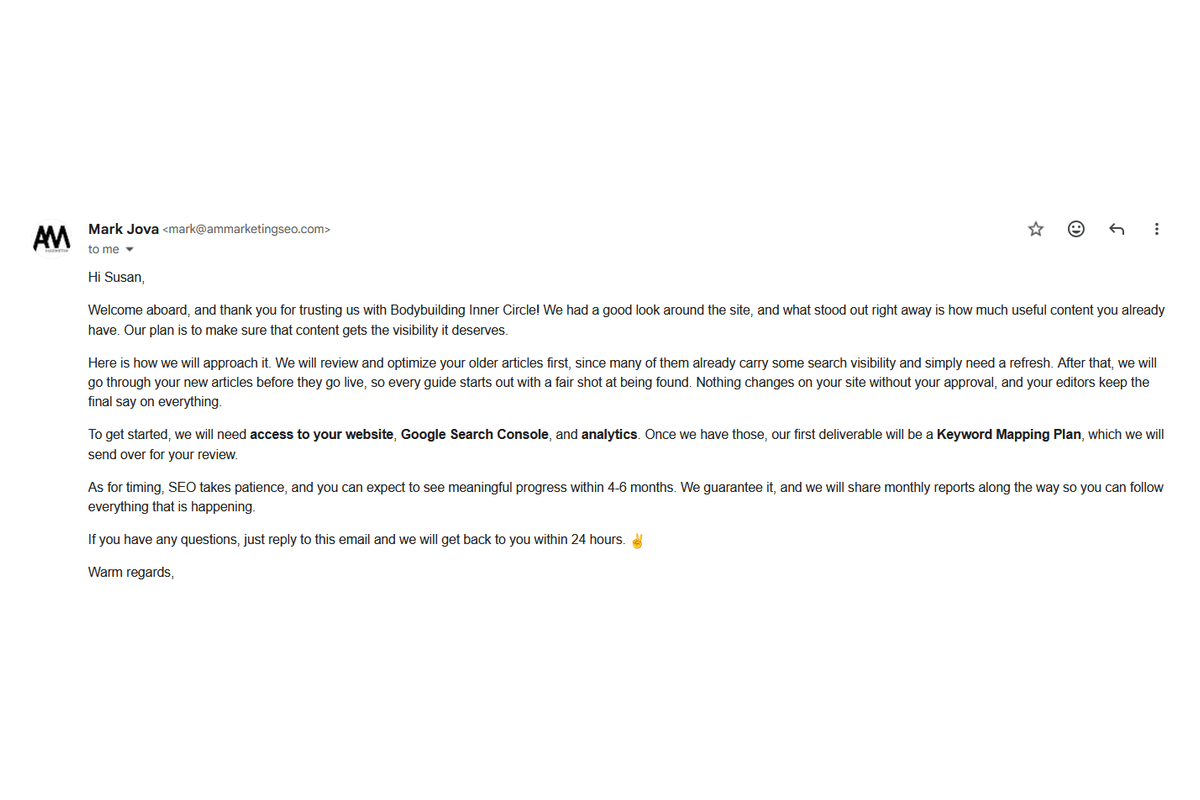
In short, AM Marketing SEO would review and optimize our older articles, along with new ones before they went live, so every guide had a fair shot at being found.
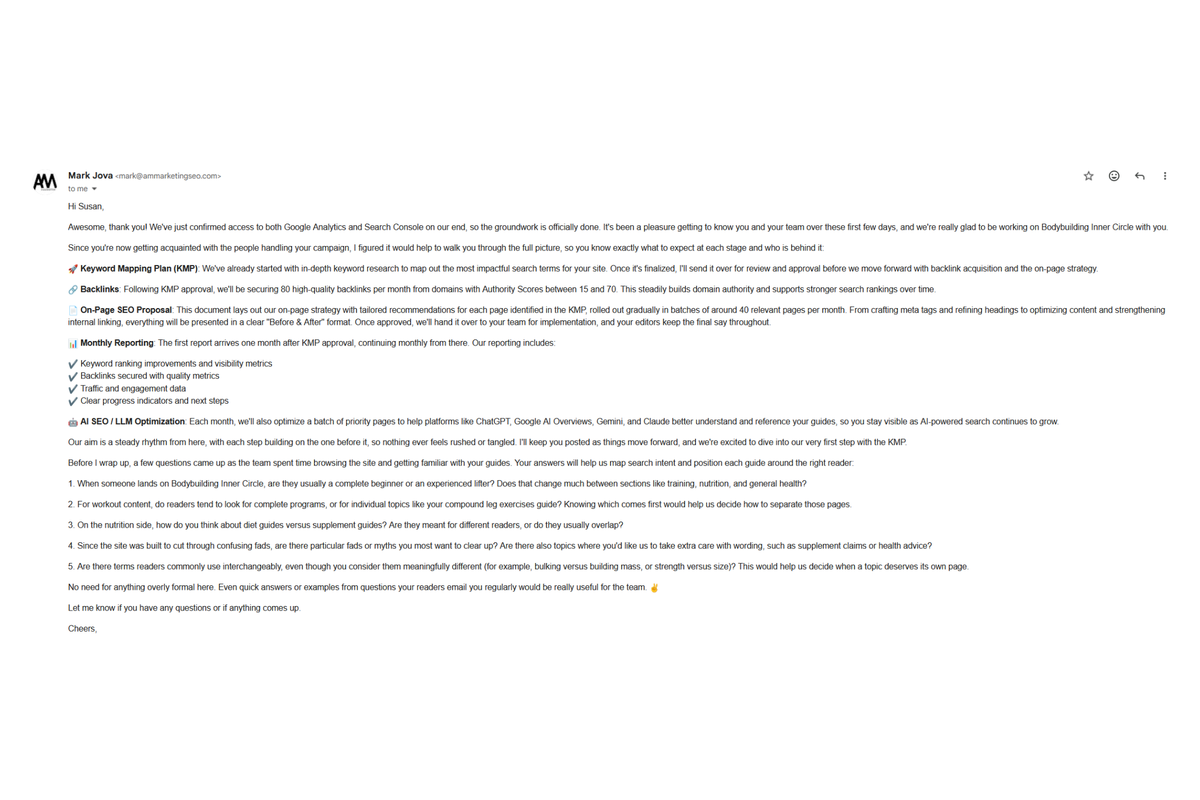
From there, onboarding was warm and welcoming. We sorted out access, got acquainted with the people handling our campaign, and before long, things were moving along steadily.
Now, you might be wondering how much a setup like this set us back, and whether we had to sell a kidney to afford it. Thankfully, all organs are still accounted for, and the price tag turned out to be one of the nicest surprises of the whole arrangement.
On Price, Since Everyone Asks
One of the first things that caught our attention was how much AM Marketing SEO included in its monthly service, all without the sort of fees we’d come to associate with SEO agencies.
There’s a fairly simple explanation for that. Their SEO team is based in Serbia, where operating costs run lower than in the US, and those savings carry through to what clients pay.
Price mattered to us, of course. Running a free fitness resource means being sensible about where the money goes, and a small fortune spent on SEO would have been pretty difficult to justify.
What appealed to us was getting keyword research, on-page optimization, technical SEO, backlinks, and monthly reporting under one roof, instead of paying several specialists to look after different pieces of the puzzle.
As for the offshore arrangement, it rarely crosses our minds these days. We send emails, review recommendations, approve changes, and receive reports, with no need to wonder where anybody happens to be sitting.
Mind you, a low price only counts for something when the product delivers, and we’ve seen plenty of bargain supplements that taught us that lesson. Here, the work gets done, the communication is straightforward, and you can see where your money is going, so the whole thing becomes considerably easier to justify.
For us, that has been the appeal. We get to concentrate on making Bodybuilding Inner Circle useful to readers, while someone else handles the search side of keeping those guides visible.
Communication Without the Unnecessary Meetings
We never set out to become professional meeting attendees, and we’re happy to report that working with this team requires no performance of any kind. After dealing with agencies that want a weekly video call just to confirm everyone is still alive, this has been a lovely change of pace.
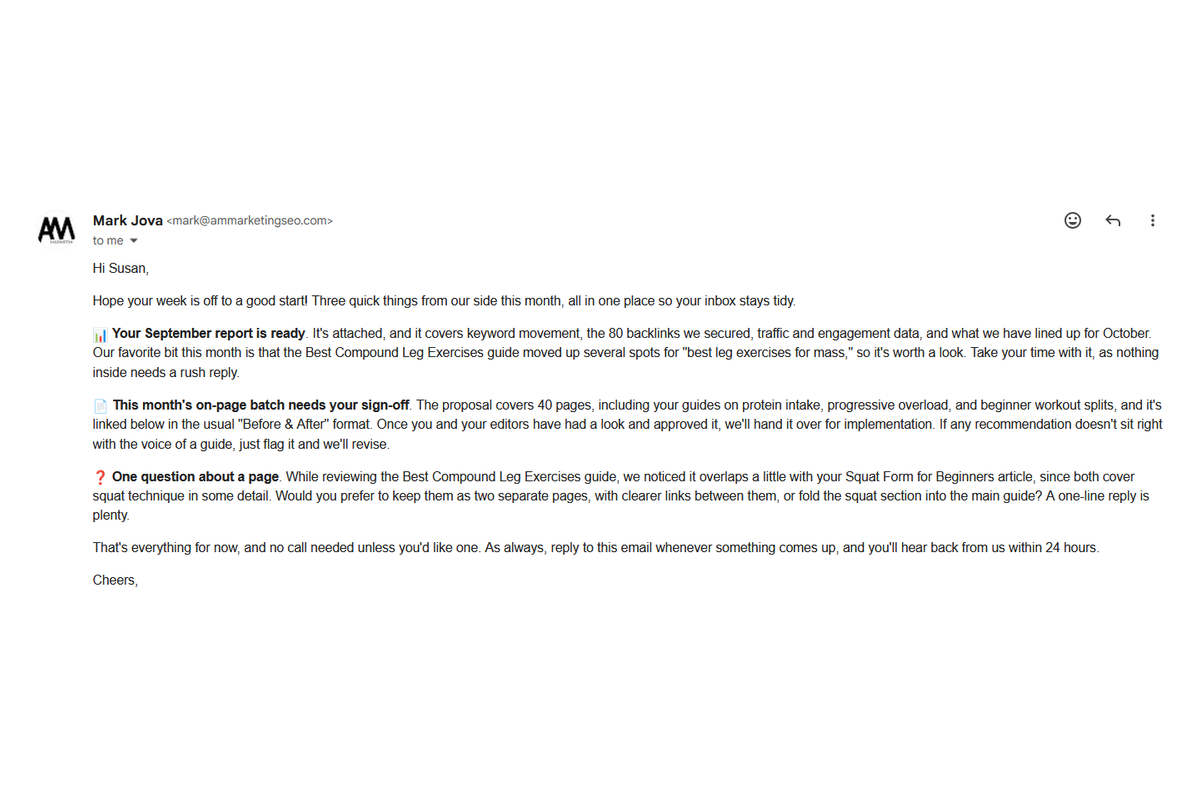
Most contact happens because something concrete needs doing. A report is ready. An article needs sign-off. Someone has a question about a page. Simple as that.
Support is email-based, with a 24-hour response guarantee, so there are no standing status meetings eating into our week. When something needs a longer explanation, we ask, and we get a clear answer without the runaround.
And since email is also how our own readers get in touch with us, the whole arrangement feels like a perfect fit. Everything stays in one place, conversations are easy to pick up where we left off, and nobody has to rearrange their day for a question that could be answered in two sentences.
The First Few Months Moved Slowly, but Steadily
Nobody promised us an overnight transformation (the initial email did include a 4–6 month guarantee, for the record), and to their credit, nobody pretended otherwise.
Step one was access: the site, Google Search Console, analytics, and the rest of the usual groundwork. Then came a few weeks of the team getting oriented, which takes a little longer when the archive is big. Think of it as the warm-up set before the heavy lifting.
The first major deliverable was a Keyword Mapping Plan, which paired search terms with pages that already showed promise and flagged a few gaps we had missed.
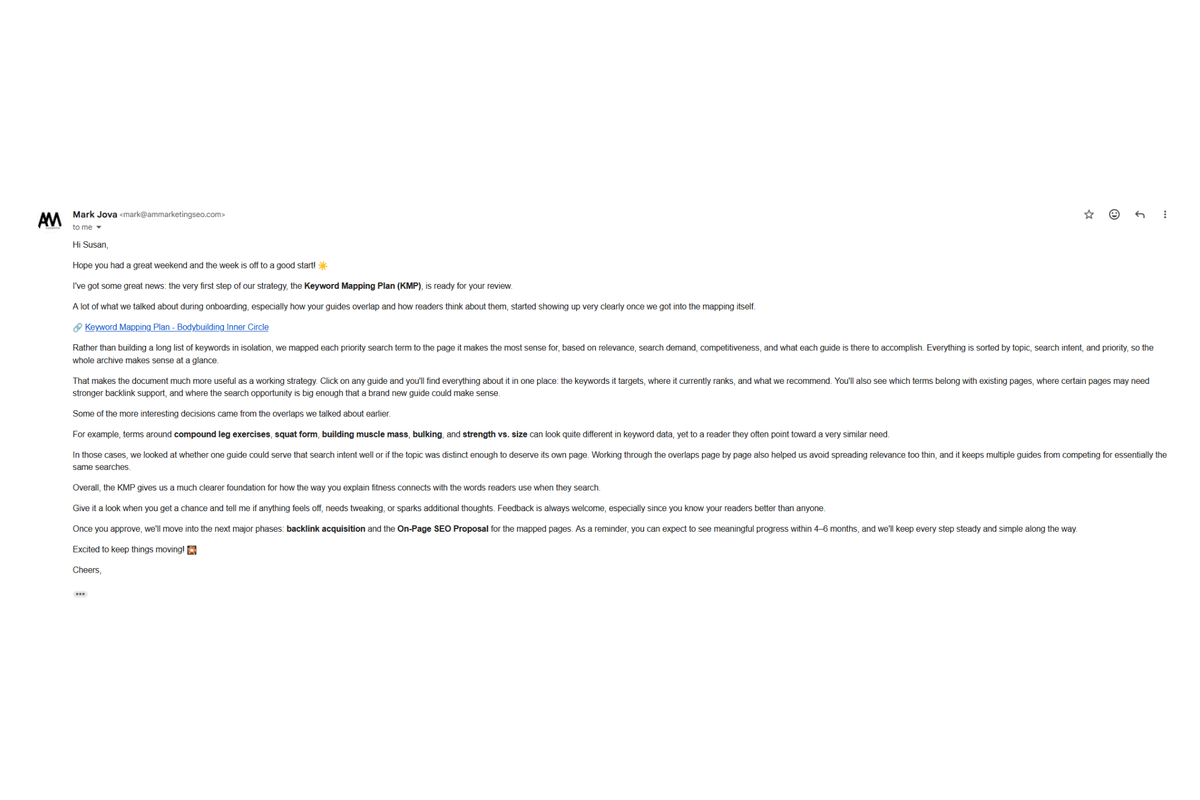
Come to think of it, that document is one of the most useful things we have ever received from an agency. It pairs every keyword with the right page and sorts everything by topic, search intent, and priority, so the whole archive suddenly makes sense at a glance.
For a site with a big pile of articles, that’s a real gift. We can pick any guide, click on it, and find everything about it in one place: the keywords it targets, where it currently ranks, and what the team recommends. No digging through twenty different tabs, which suits a site that was built to put information in one spot.
Once we approved the Keyword Mapping Plan, the next steps followed in a natural order, and the word that kept coming to mind was simplicity. Each stage built on the one before it, with nothing tangled or overcomplicated along the way, which happens to be exactly how we like our guides.
Why Simple Guides Were the Whole Point
Bodybuilding fads come and go at a dizzying pace, and anyone new to the gym ends up buried under conflicting advice. We started this site to untangle all of that, one plain-spoken guide at a time, because at the end of the day, keeping it simple is the key to success.
What caught us off guard was how neatly the Keyword Mapping Plan lined up with that mission.
Every search term in it came from a real person asking a real question, and a lot of those questions were refreshingly basic: how to start a workout program, what to eat to add muscle, how to tell a fad from something that works, and so on.
Pinpointing those keywords gave us a clear list of topics to cover, and the articles we wrote around them went on to perform beautifully.
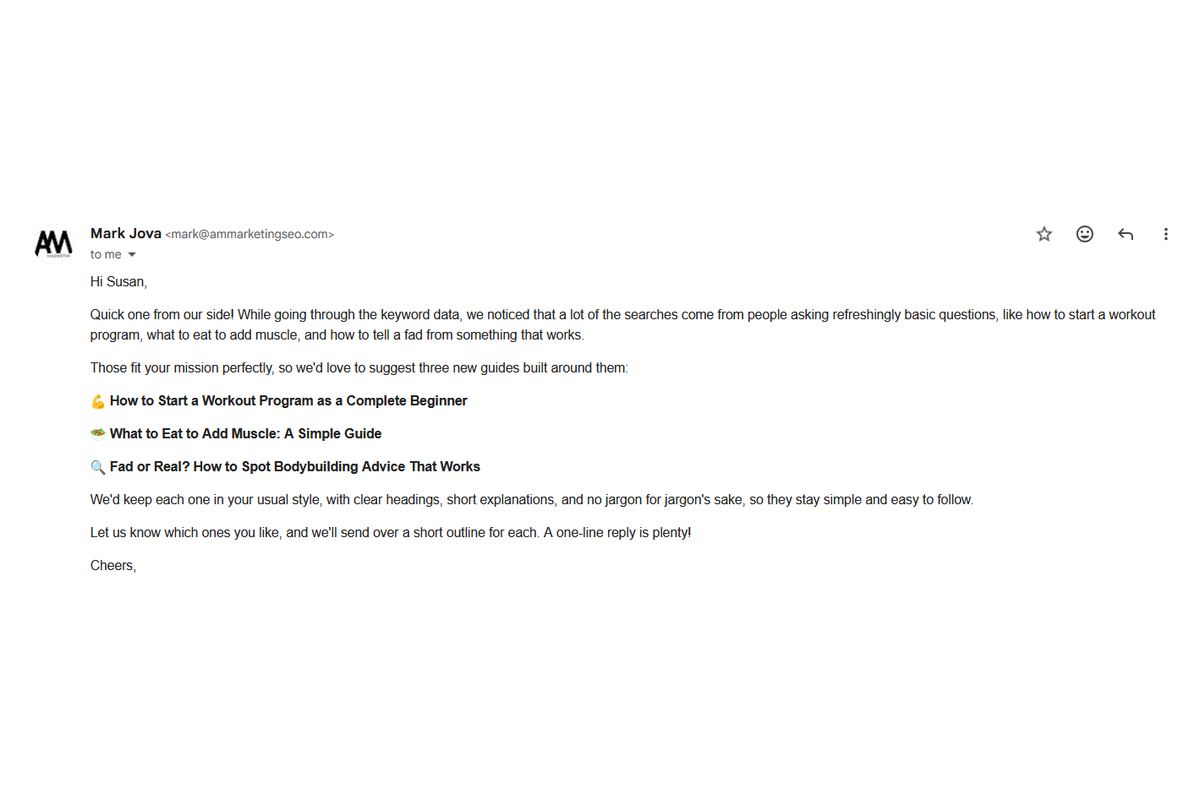
That further nudged us toward writing and refreshing guides at exactly the level those readers needed, with clear headings, short explanations, and no jargon for jargon’s sake.
Looking back, the SEO team’s work on our archive sharpened our identity as the place where fitness makes sense, and that counts as a big part of the value for us. An SEO engagement that pulls a site away from its mission would be a poor deal at any price, whereas this one pointed us straight back at ours.
Then It Got Hands-On, Article by Article
Once the planning phase wrapped, recommendations started arriving for individual pieces. Titles, headings, meta descriptions, internal links, article structure, and sometimes the copy itself.
Everything comes to us for review first, and we make the final call on what runs. That matters to us because we like our guides to stay simple, friendly, and easy to follow.
For example, say we wanted to publish another guide about how much protein you need to build muscle. Rather than automatically adding another article to the pile, the team might point us toward our existing protein calculator and suggest expanding the information around it, then linking to our related nutrition guides.
We like that way of thinking. Why make readers hunt through three different pages when we can make the one they already found more useful? It also saves us from publishing new content just for the sake of having something new.
We never wanted our articles to read like they were built around a keyword spreadsheet. The team has respected our voice while working SEO into what was already there, and our content still sounds like us, which makes us very happy.
Yes, There Are Backlinks, and Here Is How They Work
Backlinks are a real part of the service, and they’ve been secured every month since we approved the Keyword Mapping Plan.
Our favorite part is that none of it feels like those spammy links you sometimes find buried in random comment sections, with absolutely nothing to do with the page they’re pointing to. The team vets the websites they work with, and the placements come with actual information we can check for ourselves.
In other words, every link gets reported back with its URL, placement, and metrics attached, so we can compare month over month and see exactly what’s been secured.
The websites also fall within a Domain Authority (DA) range of 15-70. The guys explained what that means (it’s a third-party metric estimating a website’s ranking strength, not an official Google score), and while we won’t pretend to be experts on every SEO metric, we appreciate knowing there’s a vetting process behind the numbers.
Honestly, having that steady flow of backlinks, with all the details laid out for us, is a pretty big part of what makes the monthly price tag feel worthwhile. Especially since we’d have absolutely no desire to go chasing those placements ourselves!
Reviving Older Guides Became the Biggest Win
If you had asked us at the start where the value would come from, we would have said new content.
It turned out that the older guides, the ones coasting on leftover traffic, offered the best return. There is always another topic to write and another reader question to answer, so a solid older article rarely gets a second glance unless someone flags it.
Take our Best Compound Leg Exercises guide, for example. It already covered everything from squats and deadlifts to lunges and hip thrusts, so another leg-day roundup would have been redundant. Instead, the team helped us sharpen the headings, tidy up the structure, and improve the internal links, which made the existing guide easier to navigate and a better fit for what people were searching for.
AM Marketing SEO has become very good at spotting exactly these articles, the ones already carrying some search visibility that simply need a fresh pass to serve the same readers.
The Reports Age Well
Every month brings an SEO report covering keyword movement, Search Console performance, on-page work completed, backlinks, technical issues, and upcoming priorities.
Each report lays everything out, including which keywords moved up or down, which articles were updated that month, the backlinks secured along with their URLs, and what the team plans to tackle next. Since it all arrives in the same format every month, we appreciate how easy it is to look back and track what happened and when.
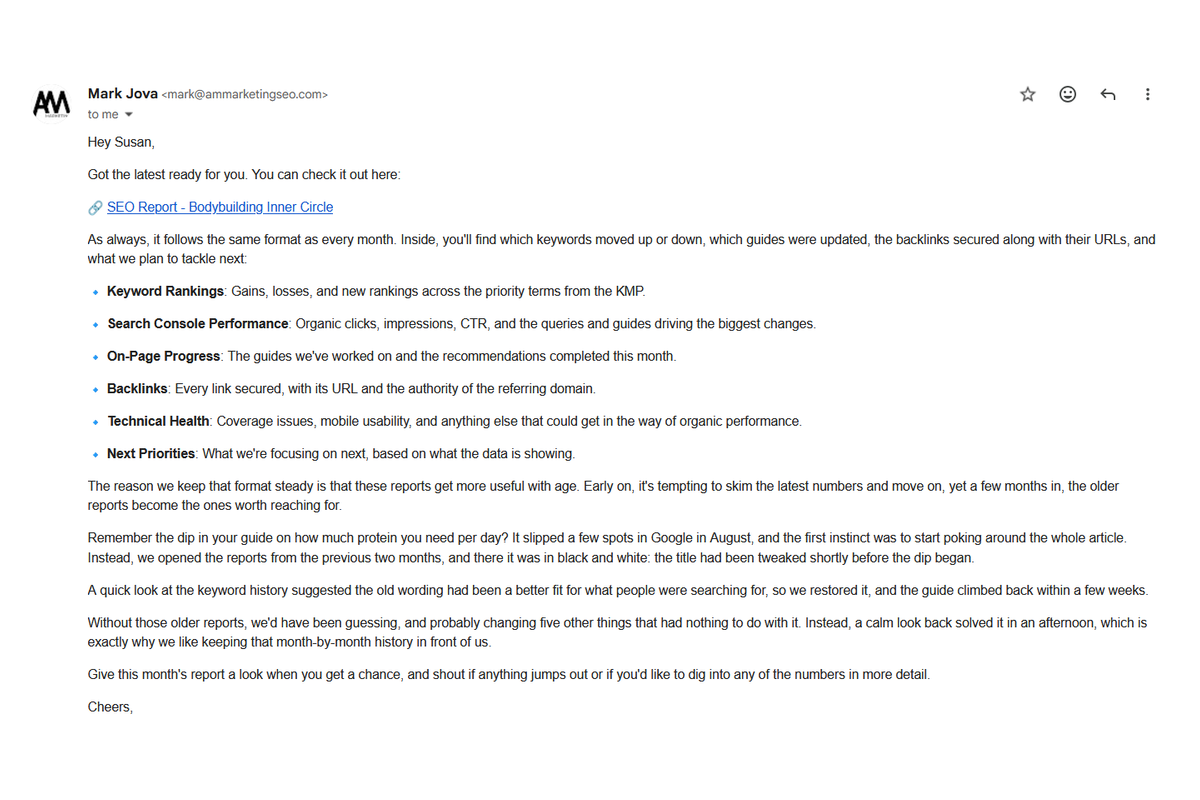
Here’s a little story that sticks with us. One month, our guide on how much protein you need per day slipped a few spots in Google, and we were ready to start poking around the whole article in a mild panic.
Instead, we opened the reports from the previous two months, and there it was in black and white: we’d tweaked the title shortly before the dip began. A quick check of the keyword history suggested that the old wording was a better fit for what people were searching for, so we restored it, and the guide climbed back within a few weeks.
Without those older reports, we’d have been guessing, probably changing five other things that had nothing to do with it. A calm look back through the reports helped us figure out what to fix in an afternoon!
What Results Looked Like
This is the part everyone scrolls down for, so here it is!
In 2025 alone, Study Breaks recorded 395,492 sessions in Google Analytics. Of those, 379,214 came from organic search, accounting for a whopping 95.88% of all traffic.
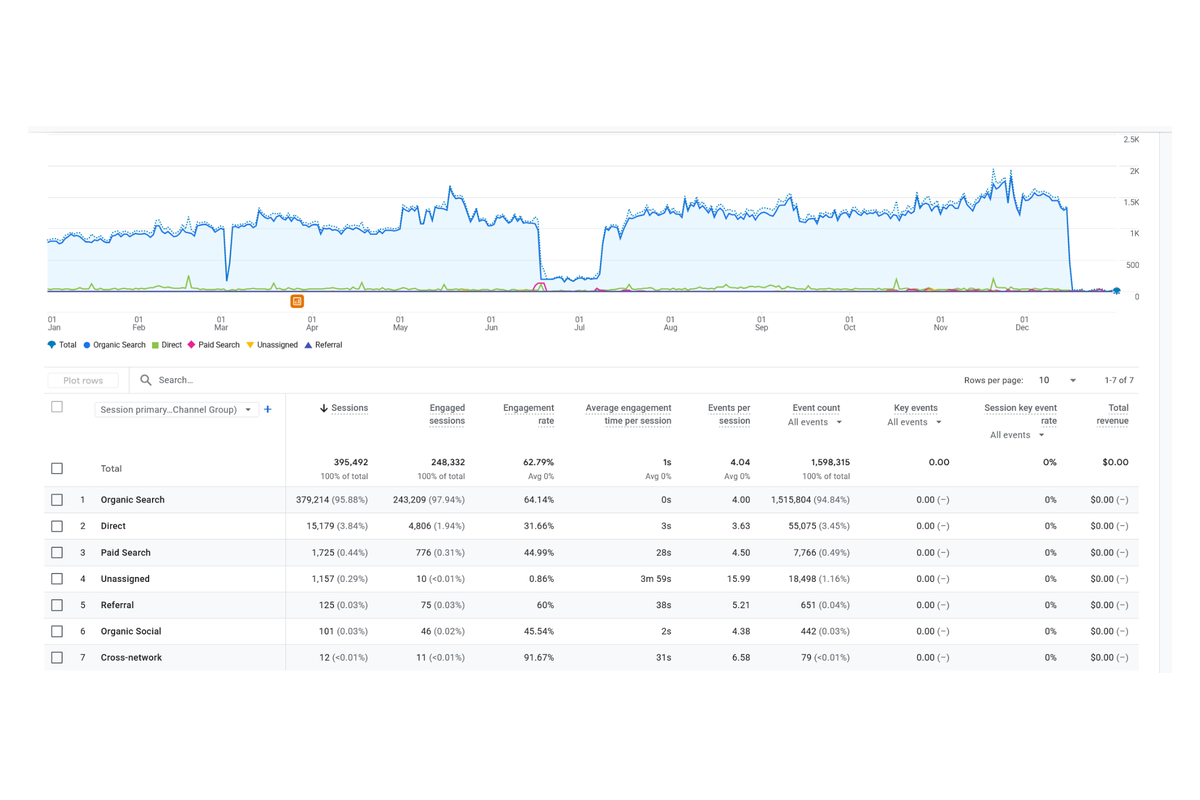
To put that into perspective, direct traffic brought in 15,179 sessions (3.84%), while paid search accounted for just 1,725 (0.44%). The difference is pretty hard to miss. Organic search also generated 243,209 engaged sessions, with an engagement rate of 64.14%, so we’re talking about a substantial number of readers actually engaging with our content.
What I particularly love seeing is just how much of our readership comes through Google. There’s something pretty satisfying about knowing an article we published years ago can still find its way to someone searching for that exact topic today.
And with AM Marketing SEO consistently finding new opportunities across our archive, that’s something we’re able to keep building on. Every refreshed article, improved heading, and better-placed internal link contributes to a much bigger picture, one we’re genuinely happy to see taking shape.
Search Keeps Changing, and So Has the Approach
Search has gotten wonderfully strange. Google still leads the way, but AI Overviews, ChatGPT, Gemini, and other answer engines now sit where people used to scroll through a plain list of results.
Fitness has always been a bit of an old-school corner of the internet, built on forums, magazines, and advice passed from one gym regular to another. Naturally, our industry took its time warming up to new technology, and we caught ourselves wondering whether guides like ours would even get a mention when someone asks an AI where to start with lifting. Plenty of people now ask a chatbot before they ask a search engine, so showing up in those answers has become part of getting found.
AM Marketing SEO has adapted the campaign accordingly, making our articles easier for these systems to understand and adding newer technical elements like llms.txt along the way. In plain English, llms.txt is a small file that points AI tools toward the most useful pages on a site, a bit like a gym map that shows newcomers where the squat racks are.
We are cautious about big claims here, since this whole area is still taking shape and nobody can say which of these practices will matter most a year from now. As a free resource that prefers to test things and watch the results, we would rather report progress as it comes than declare victory early. For now, the goal stays simple: clear content, well organized, and ready for wherever search heads next.
Our Worth-It Scorecard
Since the whole point of this review is figuring out whether AM Marketing SEO was worth the investment, we thought we’d run through the six things that matter most to a free-to-read publication like ours. Here’s how they stack up after two years:
- Did our older guides get a second life? Absolutely. Our study playlist article is one example, climbing back up Google’s rankings within a couple of months after a refresh. And it’s far from the only older piece we’ve revisited.
- Did the cost make sense next to the alternatives? Yes. We’re getting a range of services that we’d otherwise have to pay higher US agency rates for or piece together by hiring separate specialists for technical SEO, content optimization, and link building. The math works pretty nicely in our favor.
- Did our voice survive? Every bit of it. Recommendations come to us for review, our editors have the final say, and our articles still sound like something we’d actually publish.
- Could we see what was happening? Down to the individual backlinks and their URLs. Monthly reports arrive on schedule, and we can look back through two years of work whenever we need to figure something out.
- Did it save us time? Quite a bit. Keyword research, mapping, technical checks, and figuring out which older articles deserve attention no longer eat into our editors’ already busy weeks. We can spend that time doing what we’re actually here to do: publishing.
- Did it support our mission? Absolutely. Study Breaks has always been about making useful information freely available, and the SEO work helps more readers find those guides when they need them.
Put all six together, and it’s pretty easy to see why we’ve stuck around. The rankings and traffic numbers are lovely to look at, of course, but there’s a lot to appreciate about having more time for editorial work, our existing content getting the attention it deserves, and a team that understands what we’re trying to accomplish.
What We Would Tell Another Site Owner Considering This
First, expect to stay involved. You will need to provide access, answer questions, and review anything touching the live site. You know your readers best, and that input really helps when recommendations start coming in.
Second, give the process room to work. A few months shows you the early signs, while a longer stretch gives you a much clearer picture, especially with a big archive where different articles need different levels of attention.
Third, AM Marketing SEO makes the most sense for sites that already have plenty of content and haven’t had the time or resources to give it the SEO attention it deserves. That was our situation, and it is where we have seen the most value.
Finally, sites with only a handful of pages may find that a monthly engagement like this is more than they need. The value builds with the size of the archive.
So, Is AM Marketing SEO Worth It?
For us, yes. The work shows up consistently, it makes sense, and the campaign is still moving somewhere worth going.
There are still guides to revisit and rankings to improve, and we doubt our archive will ever be perfectly optimized, which is fine by us. Having a team consistently looking after that side of things has taken a good deal off our plate, and it has helped us stay true to what we set out to do: make a confusing industry a little easier to understand.
Roughly two years in, we are still a happy client, and that probably tells you more than another paragraph could. If you have questions about our experience, email us and we will do our best to get back to you!